
National Commissioner Makgothi Thobakgale announced movement on several long-running disputes after Tuesday’s convergence in Pretoria, but POPCRU has warned that promises are no longer enough.
POPCRU has warned the Department of Correctional Services (DCS) that its latest commitments will mean little without immediate implementation, after this week’s mass action forced movement on disputes over shifts, promotions, and the transfer of workers from the Mangaung Correctional Centre.
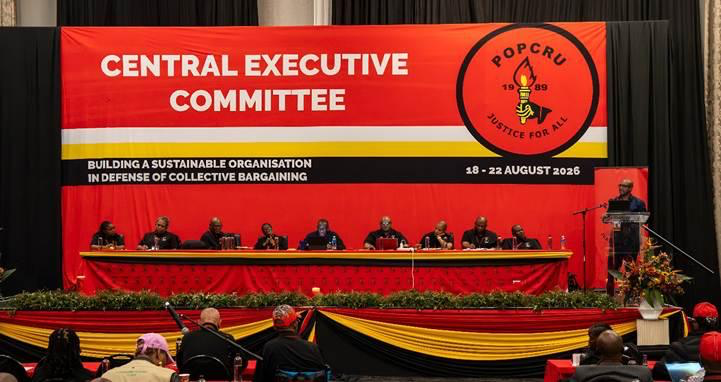
Addressing POPCRU’s Central Executive Committee (CEC) on Friday, DCS National Commissioner Makgothi Samuel Thobakgale reported back on undertakings made after hundreds of union delegates stormed the Department’s Pretoria headquarters on Tuesday and demanded direct engagement over grievances that have dragged on for years.
On the disputed Section 197 transfer of workers from the formerly privately operated Mangaung Correctional Centre, Thobakgale said DCS had agreed to stop fighting the matter through the courts and instead work towards a settlement with POPCRU.
“We agreed on Tuesday that we are not going to implement Section 197 by fighting in the courts. We will implement Section 197 by sitting down together and agreeing on how it will be put into practice,” he said.
DCS had already reached out to POPCRU’s legal team to begin discussions on a settlement agreement, Thobakgale confirmed.
The Commissioner also announced that approval had been granted for a notch increase linked to promotions, while the Department had formally approached National Treasury over the funding required to implement the long-disputed five-day-on, two-day-off shift system.
“The letter, as I speak here, is with the Director-General of National Treasury, setting out the financial implications of the five-by-two system. It is now for us to engage Treasury together,” he stated.
He emphasised that chronic overcrowding was placing further pressure on an already stretched correctional system, saying DCS facilities were currently 63% overcrowded. However, he stressed that overcrowding could not be treated as the responsibility of Correctional Services alone, describing it as a challenge confronting South Africa’s broader criminal justice system and the nation as a whole.
The pressure is being compounded by staffing constraints, DCS is currently able to recruit only 1,600 additional officials within its existing budget, even as inmate numbers continue to rise, and some officials are left responsible for extremely large prison sections.
“If you go to a correctional facility after 7pm, you will find an employee managing a section of more than 700 inmates,” he said.
But Thobakgale conceded that DCS could no longer rely on commitments in principle after years of frustration among correctional officials. “The wrongs can only be corrected by identifying them, admitting they are there, and moving beyond a commitment in principle into action. If I were to summarise Tuesday’s meeting with POPCRU in one message, it would be this: stop committing and start doing.”
POPCRU President Thulani Ngwenya acknowledged the Commissioner’s efforts, but made it clear that these undertakings alone from DCS would not be enough to halt the union’s programme of action after years of promises that had failed to translate into delivery. The union had already described Tuesday’s action as a “warning shot”, cautioning that continued failure to act would be met with rolling mass action and disruption across the country.
“What you saw on Tuesday was the beginning of the worst to come. The ball is in your hands,” Ngwenya told him.
“We are no longer impressed by commitments – we want implementation. The only person with the key to stop our programme is yourself. The only person who can stop this train from getting onto the railway line and moving is you.”
Ngwenya further pushed the Department to deal directly with recognised organised labour through the proper bargaining channels, rather than allowing organisations without recognised standing in DCS to engage on behalf of correctional officials.
He demanded that DCS be moved out of the General Public Service Sector Bargaining Council (GPSSBC) and into the Safety and Security Sectoral Bargaining Council (SSSBC), arguing that correctional officials should bargain in a structure that understands the realities of incarceration and the broader security environment.
He set 31 March as the deadline for the process, saying the migration should take effect from 1 April.
Delegates from several provinces then confronted the Commissioner directly over the Department’s failure to finalise a formal shift system since 2009, the lack of meaningful promotion opportunities, and repeated commitments they said had been allowed to disappear into endless processes. One delegate warned that POPCRU leadership was constantly left looking like it had failed its members because agreements reached with the Department did not translate into delivery.
Thobakgale acknowledged the depth of members’ frustration with the Department. “I appreciate your honesty, and the straightforwardness of the leadership. There are still many mountains to climb and rivers to cross. No one can navigate these challenges alone,” he said, adding that DCS was ready to work with POPCRU’s leadership.
However, Ngwenya made it clear to the Commissioner that the measure of progress would now be delivery. “Thank you for coming and bringing partly good news. But it will only really be good news when you have finalised these measures.”

